PROJECT 01
BANESË PËR TY
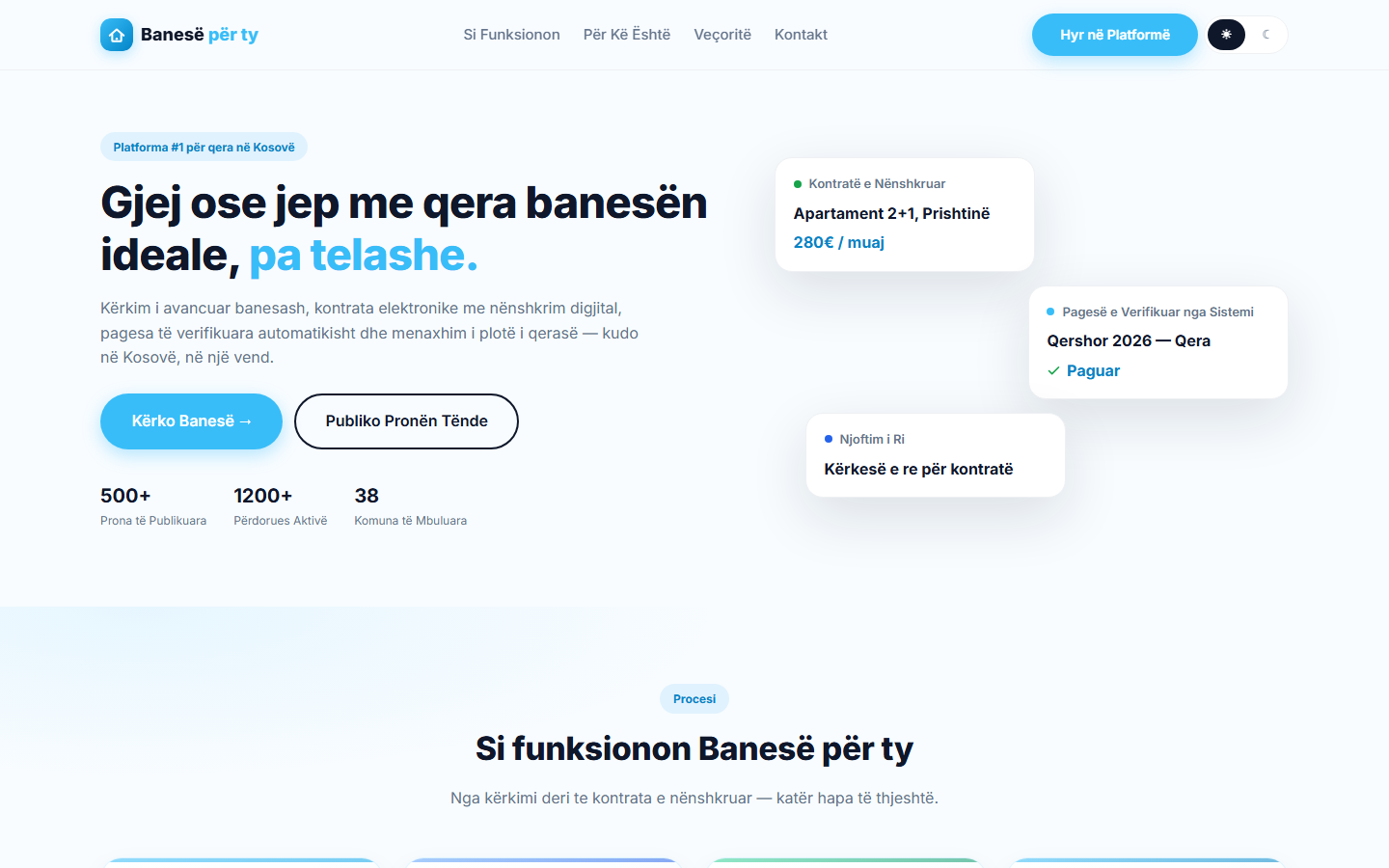
A rental platform concept where tenants search listings and landlords manage them, with digital contracts, signatures, and payment verification.
The Idea
Finding a rental in Kosovo usually means scrolling through social media posts, with no filters, no structure, and paperwork handled offline. Banesë për Ty was my attempt to answer that: one place where a tenant can search properly and a landlord can manage listings, with the rental steps that normally happen on paper moved into the browser.
What I Built
I designed and built the whole thing myself: the interface, the front-end code and the flows connecting them. It covers property listings, search and filtering, the rental process end to end, and digital handling of contracts, signatures and payment verification.
- Property discovery
- Search and filter experience
- Rental workflows
- Digital contracts
- Digital signatures
- Payment verification
- Notifications
- Tenant and landlord workflows
User Experience
The platform is designed around two primary user types, tenants looking for properties and landlords managing listings. The experience focuses on making property discovery intuitive and rental processes streamlined through clear navigation and workflow-driven interactions.
Design Decisions
The interface prioritizes clarity in property presentation, accessible search and filtering, and a clean layout that guides users through the rental journey, from browsing listings to completing digital agreements.
Technical Approach
Built with HTML, CSS and vanilla JavaScript, with no framework, and deployed on Netlify. Layout uses CSS Grid and Flexbox so listings reflow cleanly from phone to desktop, and the search, filtering and multi-step rental flows run client-side in JavaScript.
SEO Perspective
The platform is structured with semantic HTML, clear page hierarchy, and descriptive content to support discoverability. Property listings and category pages are organized to provide clear signals for search engines and users alike.
What I Learned
The hardest part was not the code, it was the state: a rental flow has many steps, and each one has to remember what happened before it. Building for two user types at once also taught me that a feature that helps a landlord can easily get in a tenant's way, so I kept cutting back until each screen had one clear job. It is the project that pushed my JavaScript furthest.